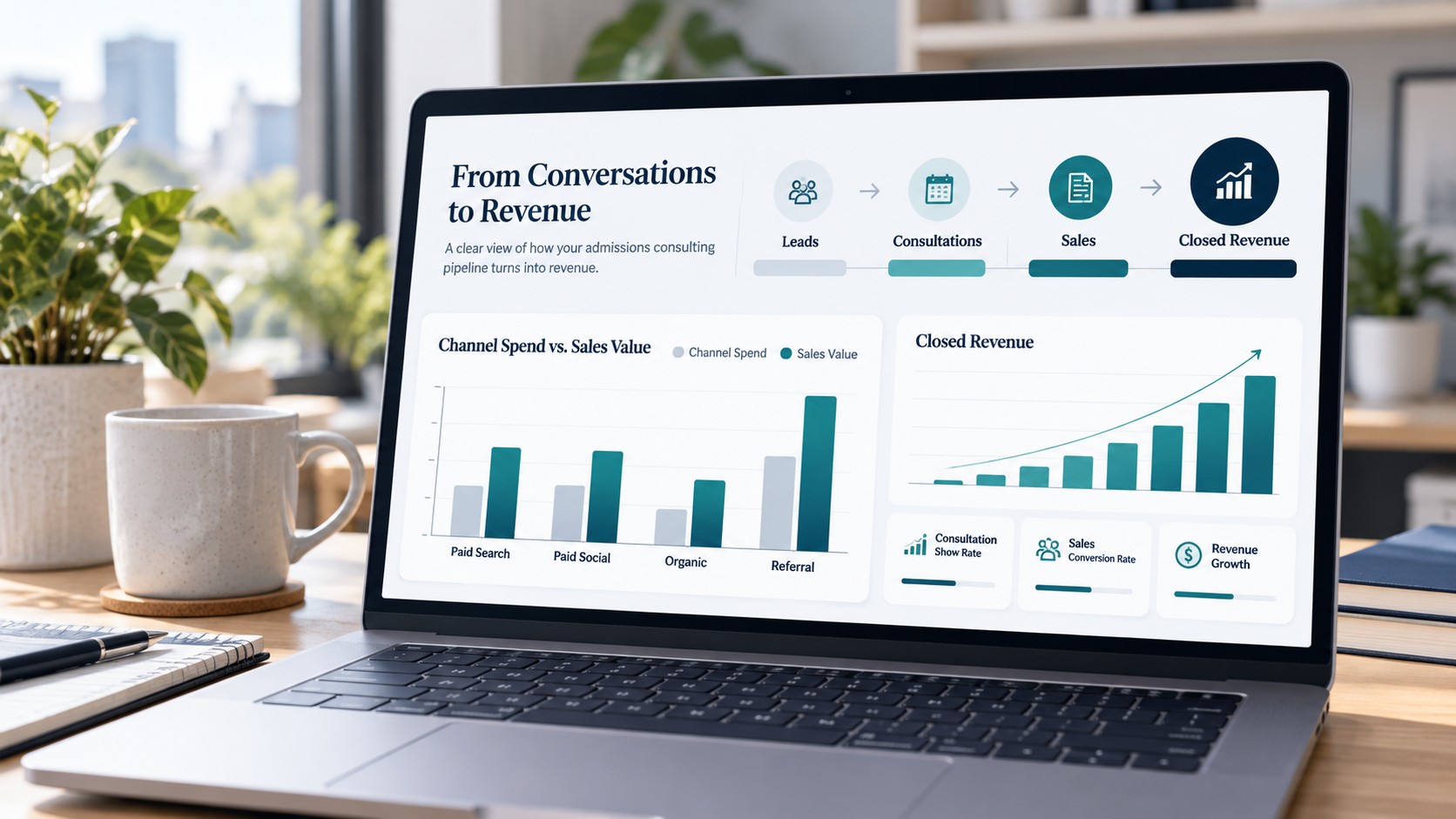
Admissions consulting companies know which marketing drives revenue by tracking each lead from its first source through the consultation, sale, and closed revenue in the CRM. That means recording where the buyer came from, whether they booked a consultation, and how much they spent when they became a client.
This applies to education businesses that help applicants get into medical school, PA school, or dental school. The sale is the consulting package the applicant buys, not a university enrollment or a patient admission.
If you run one of these companies, your marketing report should answer a simple question: Which marketing channels bring in paying clients, and what does each sale cost?
Your ad platform can tell you about a lead. It cannot close the books for you.
"We have no way to track the entire customer journey. I need a single dashboard and I can't seem to get it."
We've heard this from founders who have plenty of marketing reports but still cannot explain where their revenue comes from.
Google Ads may show a strong return based on form fills or the values assigned to conversions. Meta may report leads at a low cost. But those reports do not tell you which applicants bought a consulting package unless the final sales are tracked and connected.
Say your medical school admissions consulting company gets 200 leads from paid search. The ad report looks good. Yet your sales team closes only a small share of those leads.
If you cannot connect the closed sales to paid search, you cannot tell whether that channel earned its budget.
Our article on why marketing spend doesn't connect to closed revenue explains where that gap begins.
The revenue trail: lead source → consultation → sale → closed revenue
The full trail starts when a buyer finds your company. It ends when that buyer purchases a consulting package and the sale is recorded in your CRM.
For an admissions consulting company, the path often looks like this:
- Lead source: paid search, social, organic search or referral.
- Consultation: a booked call tied to the same buyer.
- Sale: the advisor closes the consulting package.
- Closed revenue: the final deal amount recorded in the CRM.
Here's where the trail breaks. A prospective dental school applicant fills out a form. The lead goes into the CRM. The applicant books a free consultation using a separate scheduler. An advisor closes the sale, and billing records the payment.
Each system did its job, but the founder still cannot see which ad led to that sale.
The connected version keeps the same buyer tied to the source, consultation, deal, and sale amount. The CRM becomes the place where leadership can report what closed. HubSpot is one example, but the principle works with other CRMs.
HubSpot's attribution definitions show why contacts, deals, and won revenue must be linked for revenue reporting to work.
At Market Like a CMO, our Revenue Architecture work connects marketing sources with sales records so founders can see which activity produced revenue.
What the revenue report should show by channel
A useful admissions consulting marketing dashboard shows leads, consultations, closed sales, and closed revenue on the same report.
It also shows what each paid channel cost. That lets you compare sales results instead of judging a channel by lead volume alone.
| Channel | Leads | Consultations | Closed sales | Closed revenue | Ad spend | CRM-based ROAS |
|---|---|---|---|---|---|---|
| Paid search | 400 | 120 | 30 | $180,000 | $30,000 | 6.0x |
| Paid social | 900 | 90 | 10 | $50,000 | $25,000 | 2.0x |
| Organic search | 250 | 80 | 22 | $121,000 | N/A | N/A |
| Referral | 60 | 40 | 18 | $108,000 | N/A | N/A |
| Direct / other | 80 | 20 | 5 | $27,500 | N/A | N/A |
| Unattributed | 50 | 15 | 6 | $33,000 | N/A | N/A |
Example with made-up numbers, not client results or benchmarks. Paid social brings in more than twice the leads of paid search, but returns 2.0x against 6.0x. A lead report would favor paid social. The revenue report shows the opposite.
Keep unattributed sales visible. If a deal has no known source, it still belongs in your revenue total. Hiding those sales makes the channel report look cleaner than the data allows.
Use the same date range and clear rules for each channel. Also note whether the report counts deals by close date or by the date the lead first arrived. Those views can tell different stories.
Calculate ROAS from the revenue you closed
CRM-based return on ad spend, or CRM-based ROAS, is closed revenue from your CRM divided by ad spend.
CRM-based ROAS = closed-won revenue ÷ ad spend
It is the most direct measure of admissions consulting marketing ROI. Use the closed revenue attributed to the channel and the spend for the same reporting period and stated attribution method.
One founder put the goal this way:
"I need a minimum of a 5 ROAS on my ads to consider them worth it."
That is a buyer's target, not a benchmark for every admissions consulting company. Your required return depends on your costs and margins. The first job is to make sure the revenue number is correct.
We saw why this matters with a medical admissions company.
When we took over its paid search account, the return was 3.73x. We rebuilt attribution first so closed deals in HubSpot could be traced back to ad spend. We then measured success using closed-won revenue rather than ad-platform conversion values.
In calendar 2025, paid search returned 8.45x under the any-ad-interaction model:
- Closed revenue: $12.9 million ($12,889,452).
- Ad spend: $1,525,790.56.
- Return: 8.45x based on closed-won deals in HubSpot.
These are results from one medical admissions company, not a promised return for another business.
The key change was knowing which sales came from marketing. Once that was visible, we could use closed revenue to judge paid search performance.
One sale can have more than one marketing touch
An applicant might click a paid search ad, leave, read your website later, and then book a free consultation.
Which channel gets credit when that applicant buys?
Pick the question before you pick the attribution model.
A first-touch view gives credit to the first recorded source. An any-ad-interaction view asks whether an ad played a part before the sale. These reports answer different questions, so they should be labeled and kept separate.
HubSpot's attribution model guide explains how different models assign credit.
For the medical admissions company above, the 2025 paid search return was 8.45x under any-ad-interaction attribution. Under first-touch attribution, it was 4.78x, up from 3.57x in 2024.
The improvement held under both methods. The numbers differ because the models assign credit differently.
Under the any-ad-interaction model, paid search touched 68.5% of all closed revenue in 2025. That shows its reach across won deals, not that paid search was the only reason those buyers purchased.
Do not add up the credit across overlapping channels and call the total your company revenue. One sale can appear in more than one channel's influence report.
Send closed sales back to Google Ads and Meta
Your CRM should remain the source for closed sales and revenue reporting. But some of that sales data may also help ad platforms learn which leads become paying clients.
- Google Ads supports importing offline conversions, including sales that happen after the first online lead. Its Enhanced Conversions for Leads guidance describes using first-party data to improve matching.
- Meta supports offline events through its Conversions API. These events can provide information about later sales rather than only initial leads.
None of this means you should upload every CRM record. Sending data requires compliance with the platform's consent and first-party data rules. Data shared with ad platforms must not reveal health information. Review Google's customer data policies and the rules that apply to your account and data before sending anything.
First, make sure the CRM records themselves are right. Our post Is Your HubSpot Actually Tracking Revenue? shows how to check your revenue tracking.
Fund the channels that produce closed revenue
Your marketing budget should follow the channels that close sales at a return your business can support.
A low cost per lead may look attractive. But if those leads rarely buy, that channel may cost more per customer than one with fewer leads and stronger sales.
For the same medical admissions company, the numbers moved in opposite directions from 2024 to 2025:
- Paid search ad spend fell 4.8%.
- Closed revenue attributed to paid search rose 26.9%.
- Average deal size increased 35.2%, from $4,797 to $6,484.
Those results came from the client's closed-won CRM reporting. They show what became possible when marketing decisions used sales data rather than lead counts alone.
Before adding budget, ask which channels bring clients, what those clients buy, and how much revenue those sales produce. Review the unattributed share before making large cuts based on an incomplete report.
Our Growth Decisions service uses sales results to guide what to fund, fix, reduce, or scale.
Find out which marketing is bringing in paying clients
You should be able to trace a closed consulting package back to the marketing that helped sell it. If the source disappears between a lead form, consultation, advisor, and billing system, your revenue report cannot give you the full answer.
At Market Like a CMO, we help established admissions consulting companies connect their marketing and sales data. Healthcare marketing, accountable to revenue.
Book a free strategy session. On the call, we run a marketing diagnostic to show you which channels turn into enrolled consulting clients and closed revenue, and where your tracking loses the trail.
Frequently asked questions
How do admissions consulting companies know which marketing drives revenue?
Admissions consulting companies track marketing revenue by linking each lead's source to its consultation, closed sale, and final deal amount in the CRM. They can then compare closed revenue by channel with marketing spend. This shows which sources produced paying clients rather than only leads.
How should leads, consultations, sales and revenue connect?
Each lead should keep the same identity and marketing source as it moves from the CRM to a booked consultation and then to a closed sale. The CRM should record the final deal amount and connect it to the original buyer record. That lets the company report the full path from source to revenue.
What is CRM-based ROAS?
CRM-based ROAS is the closed-won revenue attributed to an ad channel in your CRM divided by that channel's ad spend. For example, $100,000 in attributed closed revenue on $20,000 in ad spend equals 5x ROAS. This measures return against won sales, not just the values assigned to form submissions.
Why does ad-platform revenue not match CRM revenue?
Ad-platform revenue and CRM revenue can differ because platforms may count different conversion events, use assigned values, or give credit under different attribution rules. The CRM records the sales your business marks closed-won. Compare definitions, date ranges, and attribution models before treating the difference as a tracking error.
Can Google Ads use closed sales from a CRM?
Google Ads supports offline conversion imports that can send eligible later sales outcomes from a CRM back to the ad platform. The setup must follow Google's consent, first-party data, and sensitive-information policies. The CRM should still be used to verify which sales closed and how much revenue they produced.
What should an admissions consulting marketing dashboard show?
An admissions consulting marketing dashboard should show leads, consultations, closed sales, closed revenue, and ad spend by channel. Paid channels should also show CRM-based ROAS. The report should keep unattributed revenue visible and clearly state the reporting period and attribution method.